

US vs Indian Political Campaigns: Key Differences, Election Strategies, and Voter Impact 2025
 US vs Indian Political Campaigns
Estimated reading time: 20 minutes
Thank you for reading this post, don't forget to subscribe!US vs Indian Political Campaigns: Clear Differences That Shape Elections and Voters’ Lives
Imagine towering campaign stages in the US bathed in bright floodlights, echoing with roaring crowds, while across the ocean in India, vibrant processions flood streets amid swirling colours and relentless energy. Political campaigns on both sides are spectacular, yet their styles, strategies, and stakes differ sharply. Understanding these contrasts helps us see how political battles here and there don’t just shape election results, but also affect the daily lives and political attitudes of millions.
This post explores those differences, from the role of candidate personalities and grassroots organising to the use of data, money, and media. Campaigning in the US leans heavily on a highly professionalised system with regulated finance and microtargeted messaging, while India’s campaigns blend mass rallies, deep-rooted local networks, and a rapidly evolving digital presence amid complex social dynamics. Grasping these divides sheds light on how democracy lives and breathes in two of the world’s largest nations.
Watch this for a quick overview of the differences
Structure of Political Campaigns
Campaigns in the United States and India reflect the fundamental political systems they belong to. While both aim to win voters’ support, their structures, scope, and focal points diverge sharply. Understanding these differences is key to grasping how elections unfold and how political power is gained and wielded in each country.
US campaign structure
The US campaigns revolve mainly around a clear two-party system, with the Democratic and Republican parties dominating the scene. At the centre of attention is a single candidate, commonly in presidential campaigns, who represents the party nationwide. Campaigns follow a defined path starting with primaries, moving to party conventions, and culminating in the general election.
These campaigns are highly professionalised, run by seasoned staff who coordinate voter outreach through door-knocking, phone calls, and increasingly, data-driven digital advertising. Money plays a big role and flows through regulated channels, including Political Action Committees (PACs) and super PACs. This structure fosters a strong direct link between the campaign and the executive branch since the elected president wields national authority immediately after election.
The system encourages clear, focused messaging and leverages data to target voters at the individual level. Volunteers and local party organisations support the campaign groundwork, but the central campaign team usually steers strategy and resources. Campaign finance regulations ensure transparency, though they also shape how money is raised and spent, often resulting in complex fundraising efforts.
For a detailed look into US campaign finance and organisation, the U.S. Department of State’s briefing on campaign finance offers an authoritative resource.
Indian campaign structure
India’s political campaigns occur in a vast parliamentary democracy with a multi-party system involving numerous regional and national players. Unlike the US focus on a single candidate, Indian campaigns are a blend of party and individual efforts. The country’s campaigns tend to be broad and intense, featuring massive rallies, local door-to-door outreach, and grassroots networks reaching into villages and towns.
Coalition politics are crucial. Few parties can win an outright majority alone, meaning alliances and post-election coalitions determine government formation. This complexity means campaigns not only project a national message but also adapt to distinct regional and caste-based realities.
Campaign organisations are more spread out and less centralised, with local leaders holding significant sway. The funding landscape differs too, with political donations often less regulated and more opaque, though recent reforms aim to improve transparency. Digital campaigns are rapidly evolving but traditional rallies, in-person contact, and cultural symbolism remain dominant.
The Election Commission of India oversees this enormously complex process, ensuring free and fair polls despite the vast scale and diversity. For a current perspective on India’s elections, the Al Jazeera overview of India’s election process provides valuable context.
Personalities versus parties
The US system strongly emphasises the individual candidate. The voter’s choice is often about the person’s qualities, history, and personal brand. Campaigns invest heavily in creating a direct connection between the candidate and the electorate, framing the election as a contest between two distinct leaders.
In India, the calculation is more complex. Candidates’ personal appeal matters, but party identity and alliances carry equal weight. A voter might be influenced as much by the party banner, coalition affiliations, and local leadership as by the candidate’s charisma. Campaigns balance personal stories and party platforms, often shifting significantly depending on local dynamics.
Links between legislative and executive branches in campaigns
US campaigns connect firmly to the executive since the presidential race directly elects the country’s leader. Campaign messaging, fundraising, and organisation all centre on the goal of capturing the presidency, a single, powerful office.
Indian campaigns reflect the country’s parliamentary government, where the prime minister is not directly elected by voters but emerges from the majority party or coalition in the Lok Sabha, the lower house of parliament. Winning the most seats—or building winning coalitions—is the path to power. Campaigns must therefore manage a complex interplay of parties and alliances at both national and local levels. This creates a diffuse campaigning landscape often focused as much on legislative seats as on top leadership.
The stark difference between the US direct presidential elections and India’s indirect parliamentary model shapes campaign strategies and voter priorities on each side.
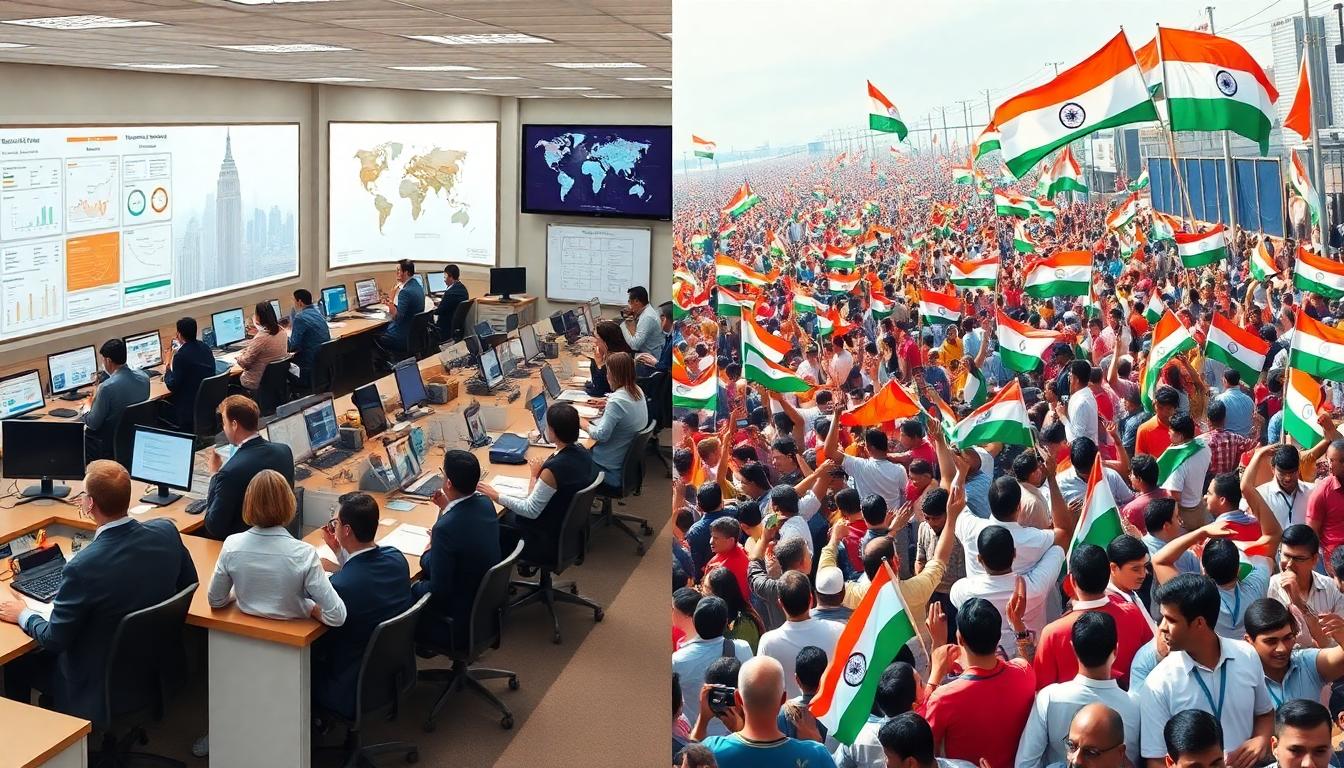
Image showing a split political campaign scene: US campaign headquarters alongside an Indian election rally. Image created with AI.
Use these insights to deepen your understanding of each system’s election mechanics and political culture. For a comprehensive overview of recent Indian election developments and coalition dynamics, the Carnegie Endowment’s analysis of India’s Fourth Party System is highly recommended.
Election Oversight and Voter Participation
Elections in the United States and India are vast civic undertakings but operate under fundamentally different systems of oversight and voter participation. Both nations strive to hold free and fair elections, yet the way they organise, register, and engage voters shows marked contrasts shaped by geography, governance, and political culture.
Centralised Oversight vs. Decentralised Management
India’s elections are managed centrally by the Election Commission of India (ECI), an autonomous body responsible for supervising elections from local panchayat polls to the national parliament. This single institution plans and executes the entire voting process nationwide. It adapts to India’s extraordinary diversity—organising elections in far-flung Himalayan villages or dense urban centres with equal precision. Automatic voter registration occurs during age verification or ID documentation, allowing continuous updates to the electoral rolls.
In contrast, the United States employs a decentralised, state-based system. Each state appoints a chief election official, often known as the Secretary of State, who coordinates with local jurisdictions to run elections. This division means variations in voting rules, registration procedures, and ballot methods across states. The U.S. federal government plays a regulatory role, setting baseline standards through laws like the National Voter Registration Act, but much authority remains local.
This difference affects everything from ballot design to voter ID requirements and challenges uniformity but offers flexibility tailored to regional needs. The multi-layered American system can complicate election oversight but embeds governance closer to voters.
Voting Technologies: EVMs and VVPAT in India, Varied Methods in the US
India’s voting experience centres on Electronic Voting Machines (EVMs), paired with the Voter Verifiable Paper Audit Trail (VVPAT) system. Voters press a button on the EVM; the VVPAT then prints a slip showing their choice, visible through a window for a few seconds before dropping securely into a sealed box. This blend provides speed, accuracy, and an audit mechanism, increasing transparency and trust. The ECI continuously updates and safeguards this technology, making it simpler to manage millions of votes quickly.
The US uses a patchwork of methods—paper ballots, touchscreen machines, optical scanners, and some jurisdictions even allow mail-in or absentee ballots. Early voting and vote-by-mail have expanded significantly, especially in states like California and Colorado. These options add convenience but raise debates on ballot security and verification. The system accommodates high voter mobility and varied accessibilities but demands careful election-day management.
Voter Turnout and Polling Logistics: Scale and Challenges
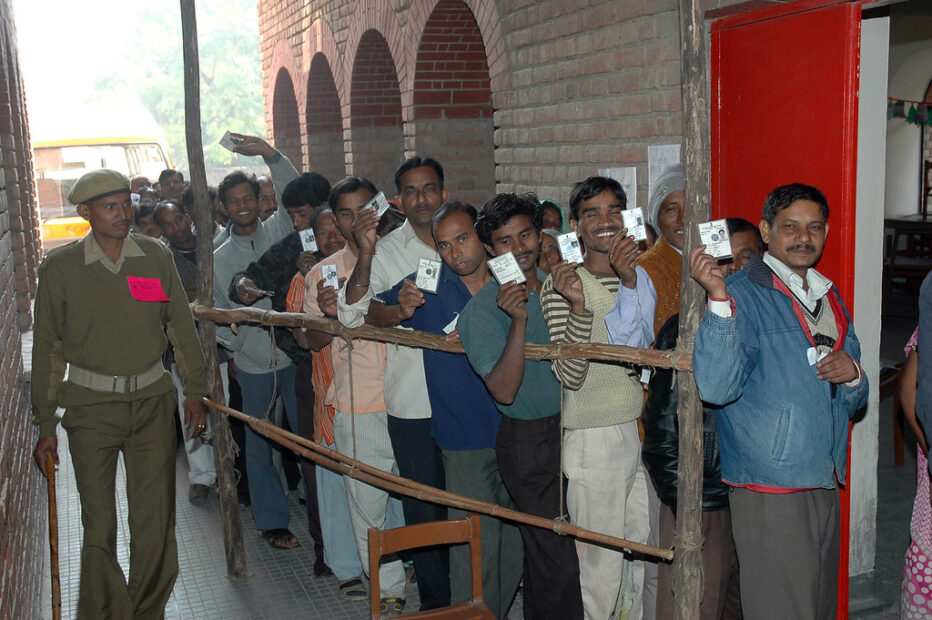
India conducts polling at over a million booths across diverse terrains including remote islands and mountainous regions, often under tight security to ensure peaceful voting. Polling booths tend to be simple, community-based centres, easy to find and accessible for most citizens, which enhances participation. Voter turnout has varied but often exceeds 60%, reflecting intense political engagement in the world’s largest democracy.
The US offers various voting options—early voting periods, mail-in ballots, and election-day polling places—designed to make participation flexible and convenient. Turnout fluctuates by election type and location but tends to hover around 50-60% for presidential races. Managing early voting and mail ballots requires robust systems to track and count votes without errors or delays.
| Aspect | India | United States |
|---|---|---|
| Election Oversight | Centralised Election Commission | Decentralised state/local officials |
| Voter Registration | Automatic registration during census and ID verification | State-managed registration, varies widely |
| Voting Technology | EVM with VVPAT for verification | Mix of paper ballots, electronic machines, mail-in voting |
| Polling Stations | Over 1 million across diverse areas | Thousands per county, accessible by varied methods |
| Voter Turnout | Typically 60%+ | Approx. 50-60% for major elections |
| Voting Flexibility | Mainly in-person, one-day voting | Early voting, mail-in, absentee, in-person |
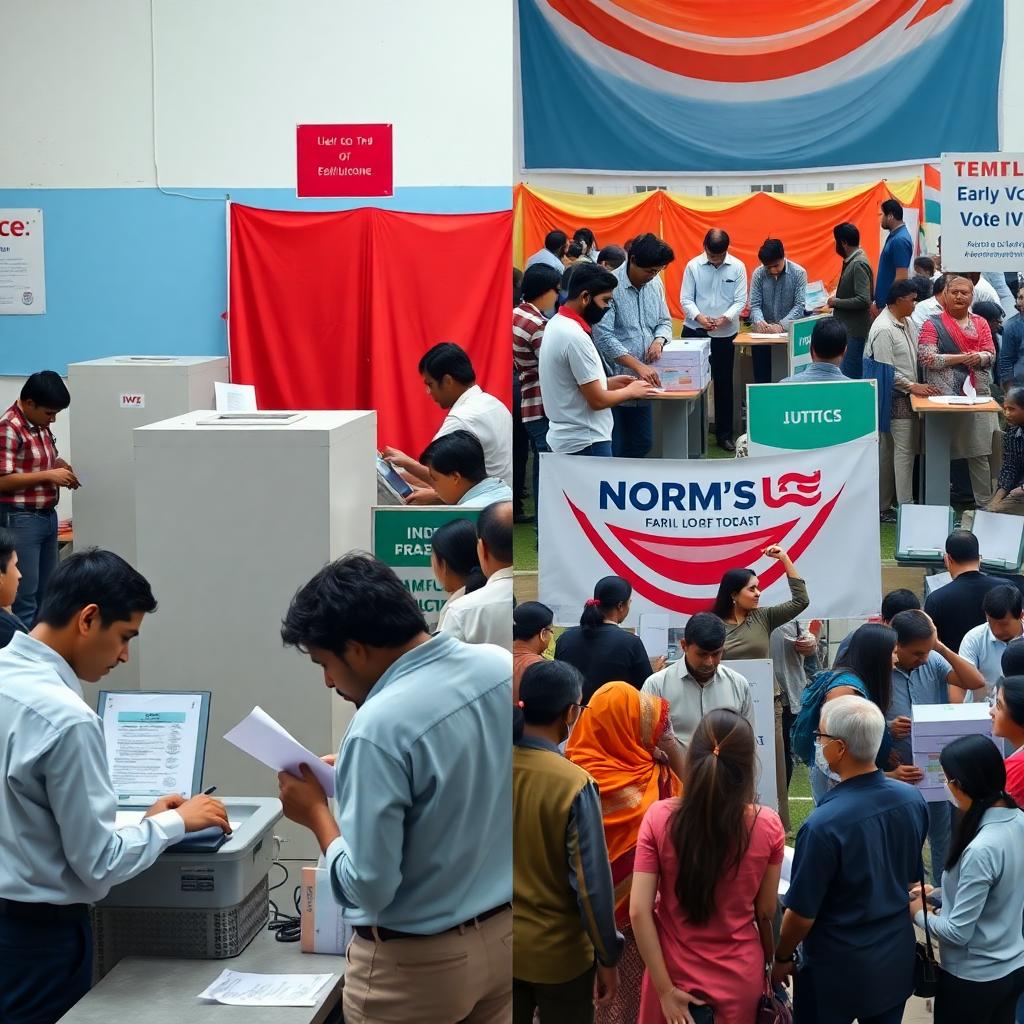
Image shows a split view of India’s electronic voting with EVM and VVPAT on one side and US voters using various voting methods, illustrating their election processes. Image created with AI.
Both systems face unique hurdles but show how distinctive approaches to oversight, technology, and voter access reflect their political landscape and society. India’s centralised but resource-intensive logistics contrast with the US’s decentralised but diverse patchwork of voting options.
For more on India’s voting machines and audit trails, the Election Commission of India’s detailed explanation of EVM and VVPAT is quite informative. Similarly, the U.S. Election Assistance Commission offers a clear overview of federal election laws and state roles in managing elections here.
Campaign Finance and Advertising
Campaign finance and advertising form the backbone of political contests in both the US and India. However, the size and style of funding and the way campaigns communicate differ sharply between the two nations. Money, while indispensable everywhere, is shaped by strict rules in India and towering fundraising machines in the US. Advertising in the US is dominated by costly television and digital ads, whereas India is rapidly embracing social media alongside large, colourful rallies.
Funding: Limits and Magnitude
In the US, campaign finance runs on a colossal scale powered by donations from individuals, Political Action Committees (PACs), and super PACs. Candidates must adhere to contribution limits set by the Federal Election Commission, but outside groups often spend unlimited amounts on behalf of candidates. This has led to an environment where candidates raise hundreds of millions of dollars. The fundraising effort is relentless, often involving high-profile dinners, online crowdfunding, and large donor networks.
India’s system takes a different route. The Election Commission of India clearly caps how much candidates can spend: for example, a Lok Sabha candidate’s expenditure limit is around ₹95 lakh (roughly $120,000), with state assembly candidates facing lower ceilings. These caps aim to curb excessive campaign spending but often don’t tell the full story. Political parties receive funds from electoral bonds, a form of anonymous donation that critics argue clouds transparency. Despite attempts to tighten regulations, under-the-table funding and informal collections persist in many areas.
| Aspect | United States | India |
|---|---|---|
| Spending Limits | Strict individual and PAC limits but unlimited outside spending via super PACs | Expenditure caps per candidate enforced by Election Commission |
| Fundraising Scale | Massive fundraising machines, often hundreds of millions per presidential cycle | Moderate candidate spending; party funds supplemented by electoral bonds |
| Transparency Concerns | Dark money with undisclosed donors through certain political entities | Electoral bonds criticised for opacity and allowing anonymous donations |
You can explore official details on US contribution limits on the Federal Election Commission’s website. For India’s spending rules, the Election Commission of India’s limits document provides clear insights.
Advertising: Paint, Pixels and Persuasion
The US political battlefield is famously painted with television broadcasts filled with polished ads and sharp messaging. Campaigns spend vast sums to purchase prime TV slots that reach millions. This is combined with targeted digital efforts, especially on platforms like Facebook and Google, where advertisers can microtarget specific demographics. The amount of digital ad spending has surged, reaching hundreds of millions in recent elections, creating a complex web of messages voters encounter daily.
India’s political advertising still thrives on spectacle: huge rallies bursting with banners, flags, and loudspeakers. However, a significant change is the booming rise of digital campaigning. WhatsApp, Facebook, Instagram, and regional apps increasingly shape voter impressions, especially among younger voters. The mobile-driven reach helps parties bypass traditional media filters, but it also fuels challenges like misinformation and viral propaganda.
Both countries deal with controversies around advertising funds. The US faces backlash over “dark money” groups that pour undisclosed sums into ads influencing voters without revealing their sources. India struggles with opaque donations through electoral bonds, which many say have diluted the spirit of clean elections.
Role of Social Media in Campaigns
Social media acts as a powerful amplifier in both democracies but with differing impacts. In the US, detailed data analytics allow pinpointing voter concerns, persuading undecided individuals through tailored messages. India’s social media use combines grassroots mobilisation with mass messaging in many regional languages, enabling parties to reach highly segmented audiences across vast territories.
The evolving advertising trends show that while traditional methods remain important, the future firmly belongs to a blend of big data and storytelling delivered via digital tools. Understanding these dynamics gives you a window into how millions of voters are reached and influenced in these two democracies.
For a deeper understanding of “dark money” and its effects in the US, the Brennan Center’s analysis of dark money is a useful resource. Meanwhile, for insights on India’s controversial electoral bonds, you may find the Stimson Center’s examination of India’s electoral bond conundrum informative.
Ground Game: Outreach, Messaging, and Identity
Elections are won on the ground, where political campaigns meet voters face to face. The approaches the US and India take to outreach, messaging, and voter identity show stark contrasts, shaped by each country’s size, culture, and electoral rules. Both countries know the value of personal contact, but their ground games reflect deep differences in scale, method, and what moves voters.
Outreach Tactics: From Canvassing to Crowds
In the United States, the ground game means strategic, door-to-door canvassing, phone banking, and organising volunteers to get out the vote. Campaign staff focus on micro-targeting in swing states, tapping into data to identify persuadable voters and tailor their personal outreach. Volunteers visit homes armed with scripts or phones pre-loaded with call lists focused on specific demographics or past behaviour patterns.
India’s outreach takes a broader, more visible form. While canvassing door to door does happen, it is embedded in a vast network of local party workers mobilising around villages, wards, and city neighbourhoods. Massive rallies featuring party leaders dominate the scene, electrifying crowds with music, slogans, and symbolism. Street processions often accompany these, with vibrant banners and loudspeakers filling the air.
Indian campaigns also rely heavily on caste and religion-based mobilisation. Regional identity runs deep, and parties tailor their outreach to these affiliations along with linguistic and cultural lines. It’s a ground game intertwined with social fabric, preserved by intense personal contact.
Messaging: Slogans, Issues, and Charisma
While the US ground campaign delivers messages with a data-driven precision, it often circles around a candidate’s personal brand or a handful of key issues like the economy, healthcare, or national security. The tone is generally issue-focused but framed through the lens of the candidate’s leadership style and promises. Messaging is short, targeted, and consistent, with heavy use of micro-targeting tools that send different messages to niche voter groups.
In India, messaging mixes emotive appeals and local issues with cultural identity. Campaign slogans must resonate across many languages and communities. Candidates’ charisma can turn the tide, but often it is identity politics—appeals to caste groups, religious communities, or regional pride—that dominate the narrative. Hindi, Tamil, Bengali, Telugu, and dozens of other languages filter campaign communication, while festivals and public holidays become platforms for symbolic messages linking tradition with political intent.
Identity: Voting Along Lines That Matter
The US ground game views voter identity primarily in terms of political preferences, income, age, education, and race. Parties use data analytics to classify voters—independent, swing, loyalist—and refine outreach accordingly. The focus is on winning over individuals whose support can swing a district or state. Although race and ethnicity matter, messaging is usually less explicitly based on identity group loyalty.
In India, identity runs through every aspect of campaigning. Caste, religion, language, and region form the core of political mobilisation, which is reflected in local alliances and candidate selection. Voters often align themselves along these lines, which campaigns use to build vote banks and manage coalition equations. Local networks tap into kinship, community leadership, and religious institutions to turn out the vote, making politics deeply grassroots and personal.
Both countries show how the ground game is about more than just votes — it builds connections, shapes political identity, and enacts democracy in action. Though the methods and scale differ sharply, the goal remains the same: reaching voters where they live, listen, and decide.
For further insights on how digital tools and apps shape India’s ground outreach, the Pulitzer Center’s report on the BJP’s use of its Saral app offers a detailed look at how data collection powers voter targeting in India. Meanwhile, studies into personalised communication in US campaigns underscore the shift toward micro-level voter contact, as discussed on ResearchGate.
Technology, Media, and the Power of Narrative
The ways political campaigns use technology and media to tell their stories reveal a lot about how democracy operates in both the US and India. These tools shape the narrative for millions, influencing how voters see candidates and issues. Yet, the choices of media platforms and storytelling styles paint very different pictures across these two countries.
US: Data-Driven Narratives and Mass Media Focus
US campaigns invest heavily in polling, data analytics, and micro-targeted online ads to craft a precise message for each voter segment. The narrative is delivered through polished TV debates, cable news coverage, and massive digital ad budgets. Television still holds sway, anchoring the campaign spectacle with nationally broadcast debates that focus tightly on candidates’ policies and personalities.
Micro-targeting on platforms like Facebook, Google, and YouTube allows campaigns to reach niche audiences with tailored messages that reflect their concerns and values. This digital precision contrasts with the broad, traditional media presence, creating a layered approach. The narrative is carefully controlled, often appearing slick and professional, reflecting the deep pockets backing these efforts.
Despite the heavy data use, candidates rely on familiar media conventions—prime-time TV, headline news stories, and viral social media posts—to keep their message visible and credible. The story arc focuses on leadership ability, policy expertise, and the high stakes of the presidency or congressional races.
India: A Tapestry of Media, Languages, and Local Stories
India’s campaign narratives unfold across a dizzying mix of media, languages, and venues. Technological tools like WhatsApp groups, YouTube channels, and AI-generated videos are woven alongside loudspeakers blasting slogans in village squares and brightly painted wall posters. Campaign messages must reach a multilingual, multi-ethnic population that often has limited access to mainstream broadcast media.
WhatsApp plays a powerful role, allowing parties to send messages directly into the hands of voters, often in regional languages. Viral forwards, audio clips, and locally tailored content spread rapidly through social networks, mixing entertainment with political messaging. This method bypasses traditional media gatekeepers, enabling grassroots mobilisation.
The narrative here blends charisma and identity, often tapping into caste, religion, and regional pride. Technology amplifies these stories but does not replace the in-person interaction or the sensory surge of rallies. AI and digital tools add a new dimension, like deepfake videos or personalised messages, but their effect is layered with the sheer volume of traditional outreach.
Tackling Disinformation and Reaching Every Voter
Both countries wrestle with disinformation and the challenges of reaching first-time or rural voters. The US combats misinformation through media literacy campaigns and fact-checking, though online echo chambers still fuel partisan divides. In India, the scale of rural voters and diverse language set makes misinformation harder to track and control. Campaigns use technology not only to spread their narrative but also to counter rivals’ claims in real-time.
India’s Election Commission and tech firms have started experimenting with AI tools to identify and flag misleading content. Meanwhile, US campaigns rely on rapid response teams and trusted media outlets to clarify or debunk false stories. The battle for narrative control continues on multiple fronts — online, face to face, and in living rooms.
Technology and media are not just tools but stages where political narratives are performed. The US shapes stories through a refined mix of mass and micro media, while India’s campaigns blend the loud and local with emerging digital reach. Both aim to win hearts and minds, proving the power of narrative knows no borders.
For a detailed examination of technology’s role in India’s elections, see the Carnegie Endowment report on technology in Indian campaigns. To understand AI’s constructive and controversial uses in India’s latest elections, the PBS overview of AI in Indian political campaigns provides current examples.
Conclusion
The differences between US and Indian political campaigns reflect their unique democratic systems and cultures. The US features a tightly regulated, data-driven model centred on individual candidates and a two-party system, while India embraces vivid mass rallies, coalition politics, and complex social identities in a multi-party environment. These contrasting approaches shape not only election strategies but how voters engage and see their role in democracy.
In both countries, campaigns are the heartbeat of representation, yet they highlight different ideas about power and participation. India’s sprawling, regional-driven contests underscore the diversity of voices, while the US’s focused, brand-led campaigns emphasise leadership personality and policy precision. Neither approach is inherently superior; they offer distinct ways to amplify people’s voices and build democratic connection.
As election season approaches, whether in Mumbai or Madison, it’s worth reflecting on what truly moves voters. Bigger crowds and louder slogans have their place, but so do targeted messages and careful organisation. The challenge is to ensure these campaigns keep democracy’s promise alive—by making every vote count and every voice heard. Watch the next election unfold with fresh eyes, wherever you are.